A Seal Kept Wearing Out Fast: The Cause Was
A Metre Away
A food processing plant near Wrocław was replacing a rotating seal far more often than its specification predicted. The first look pointed to a classic rotor imbalance. The second look — focused not on the machine, but on the bracket holding it — found the real cause.
Premature rotating seal wear is one of the most costly, recurring problems in food processing: every unplanned replacement means a line stoppage, product contamination risk, and the same repair cycling back a few months later. At this plant, the seal was failing well ahead of its expected service life, repeatedly, even though the machine itself passed standard inspections without issue.
The first VibraVizja® measurement focused where most teams instinctively look: the rotating assembly itself. And indeed, the amplified video clearly showed an imbalance signature at 1× running speed — the characteristic orbital shaft motion imbalance produces. That was a real finding. It just wasn't the whole answer.
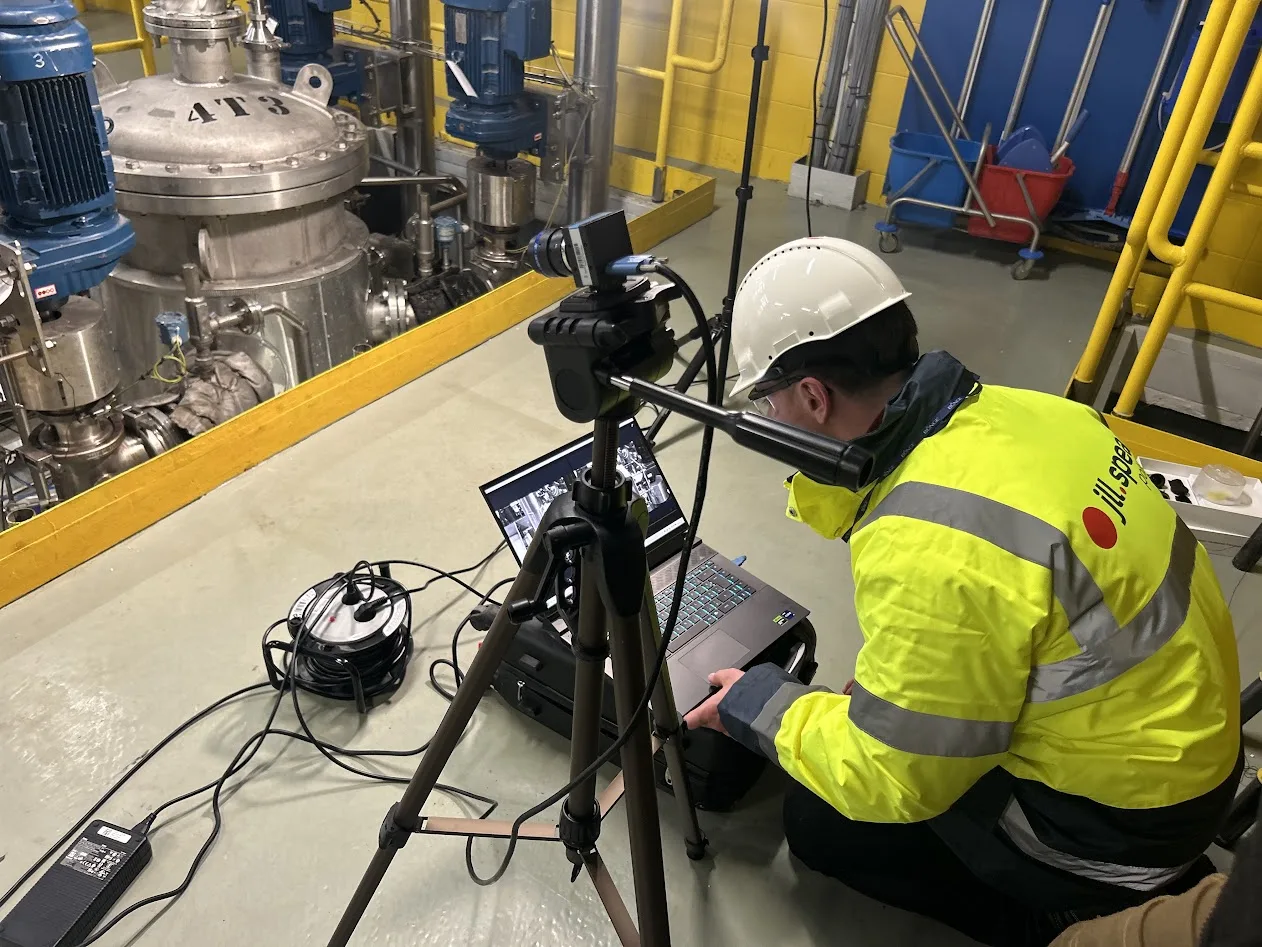
'The shaft imbalance was real. But the question that mattered was: what was holding it up?'
The Second Look: The Bracket, Not the Shaft
Imbalance on its own rarely progresses fast enough to explain such accelerated seal wear. Rather than stopping at the first result, the measurement was extended to a second configuration — the camera pointed at the support bracket, a structural element nobody had previously suspected.
The Measurement: Two Configurations, One Session
The entire measurement was performed during normal operation at full production load — no sensors, no line stoppage. A full-field view of the rotating assembly was captured first, then the camera was focused on the bracket itself. Both sequences together took just over ten minutes.
The Discovery: The Deflection Driving the Problem
The amplified footage focused on the bracket revealed something no visual inspection would have caught: excessive dynamic deflection of the structure under operating load — a level of compliance inconsistent with the design intent. Frequency analysis of that deflection correlated exactly with the machine's running speed, confirming that the bracket's structural response was what was driving the cyclic displacement of the rotating assembly.
In other words: the imbalance the first measurement had detected at the shaft was largely a symptom, not the root cause. An insufficiently stiff bracket was letting the whole assembly move eccentrically under load — and that eccentric loading was what was wearing out the seal so much faster than it should.
Insufficient stiffness of the support bracket. The bracket's dynamic compliance under operating loads was generating cyclic displacement of the rotating assembly, producing the eccentric loading responsible for the premature seal wear. The maintenance team corrected the bracket on-site.
The Result
Had the measurement stopped at the first result, the repair would have focused on the shaft and bearings — and the problem would have returned within months, just as it had before. Extending the measurement to a second configuration, aimed at a structural element nobody suspected, revealed the real root cause and let the team fix it once, permanently.
This is exactly the kind of measurement — no sensors, no downtime, results visible on-site — that we run free of charge at plants across Poland, from Wrocław to Silesia.
How vibration amplification transforms condition-based maintenance — from root cause analysis to post-repair verification.
Why point sensors struggle to locate a vibration source, and how full-field measurement reverses the diagnostic sequence — exactly as it did in this case study.
See Also
See What VibraVizja® Finds on Your Machines
We travel anywhere in Poland and run a live measurement on one of your assets while it is running at full load — no production stop, no sensors, nothing attached.
Request a Free On-Site Trial