Before You Replace the Motor: The Real Source of Vibration
Found with Vibration Amplification
An industrial lathe in a technical maintenance workshop in Périgueux, France was vibrating unusually. Everyone suspected the motor, and an expensive repair or replacement looked like the obvious next step. A diagnostic study showed the motor was not the main problem.
Operators reported unusual vibration on the industrial lathe in the technical workshop. The motor looked like the obvious suspect, but any repair or replacement would have meant significant cost and downtime.
Many maintenance teams know this situation. A symptom appears and the most visible component takes the blame. If the assumption is wrong, the team replaces a healthy part — the vibration stays, and the real problem keeps causing failures. Before that decision was made, ASE Serem recommended a diagnostic study with VibraVizja™ vibration amplification and vibration analysis, carried out with partners IIDRE and ASE Serem.
- →Establish the real source of the vibration
- →Avoid an unnecessary motor repair or replacement
- →Keep maintenance costs and downtime low
- →Avoid irreversible mechanical changes based on a wrong assumption
- →Base the decision on objective data
'Treat a symptom as a clue, not a verdict. The place where you feel the vibration is not always where it starts.'
Step 1: Seeing the Motion
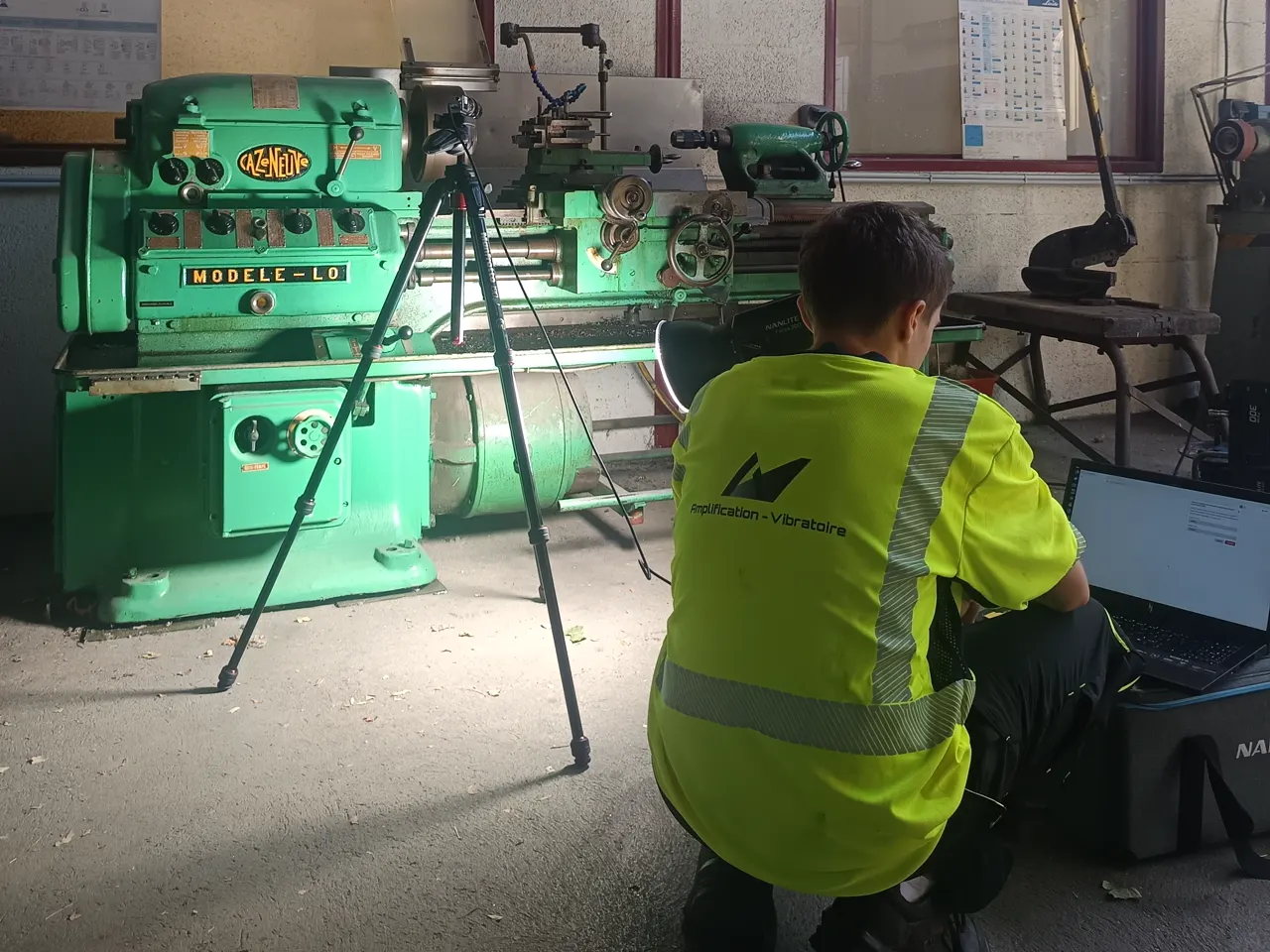
VibraVizja™ made visible the small movements the eye cannot see while the lathe was running. The vibration patterns did not come mainly from the motor. The amplified video showed instability in the machine's structure and its mounting, and attention moved from the motor to the machine's whole mechanical structure.
Step 2: Confirming the Hypothesis with Measurements
Detailed vibration analysis then verified what the images suggested. It confirmed:
- →No significant motor fault
- →Structural and mechanical looseness affecting machine operation
- →Possible alignment and geometry problems
- →Minor anomalies in the coupling and on the friction discs
The coupling findings called for careful interpretation. Excessive looseness, incorrect assembly and geometry inaccuracies create additional stress, misalignment and dynamic forces that can cause or amplify exactly such signatures. The coupling anomalies could therefore not be attributed to a fault in the component itself — they are probably a consequence of the condition of the structure.
Structural looseness and geometry problems in the machine and its mounting — not the motor. The coupling and friction-disc anomalies are most likely secondary effects of that condition.
Three Options, One Decision
The data did not justify it. It would have meant cost and downtime, and the vibration would probably have remained.
The anomalies are probably secondary effects, so this risked treating symptoms instead of causes.
Addresses the probable root cause, and can be fully verified once done.
No motor repair at this stage. ASE Serem will carry out a full geometric inspection and correction of the lathe, and check the mounting conditions and structural integrity.
The Result and Next Steps
The study has already changed the maintenance decision. The healthy motor stays untouched, downtime and spare-part costs have been avoided for now, and the team has data instead of assumptions.
The effectiveness of the corrective work is being verified in four steps:
- →Re-assessment with VibraVizja™ after the geometry corrections
- →A second round of vibration analysis to measure the effect
- →Monitoring of the lathe in real operating conditions
- →Feedback from the people who operate the machine
If vibration persists after the geometry correction, the remaining signatures can be linked to the motor or gearbox with much greater confidence. Further maintenance work will then be targeted rather than based on guesswork.
- →Treat a symptom as a clue, not a verdict.
- →Seeing the problem speeds up diagnosis. Vibration amplification showed where to look; vibration analysis confirmed what is happening and why.
- →The cheapest repair is the one you avoid. Checking the assumption first protected a healthy component and avoided irreversible changes.
- →This is decision support, not just monitoring. VibraVizja™ helped the team choose what not to do, not only what to do.
Why point sensors struggle to locate a vibration source among many candidate elements, and how full-field measurement reverses the diagnostic sequence.
How vibration amplification transforms condition-based maintenance — from root cause analysis to post-repair verification.
See Also
Want to Check Before You Repair?
If a machine in your plant is vibrating and you don't know why, let's find out together before you replace any component. We run a live measurement while the machine is running — no production stop, no sensors, nothing attached.
Request a Free On-Site Trial